

📣 Create Blog for Traders!
Stop Watching news - Start Making it.
START



Quantum FUD vs. Reality: Why Only 0.05% of Bitcoin is Practically at Risk (2026 Analysis)
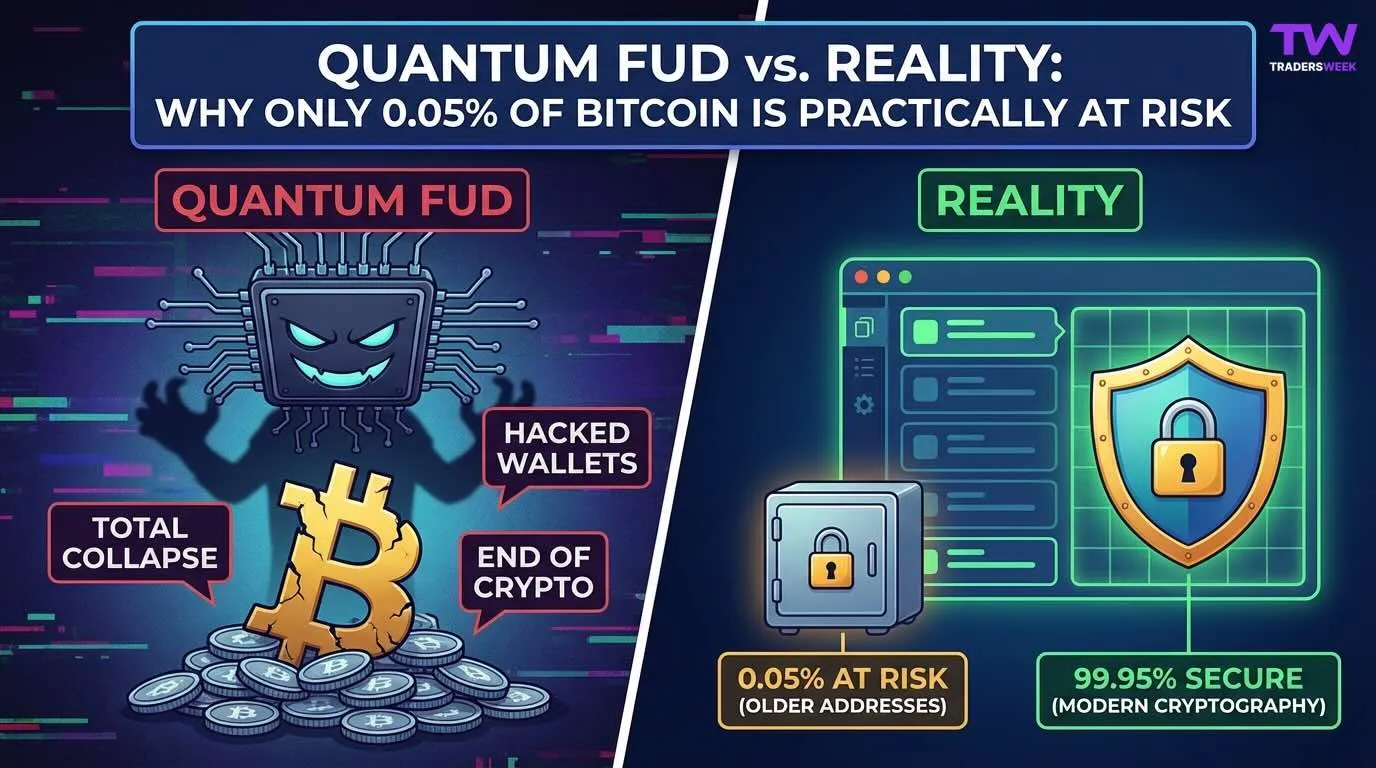
For years, the "Quantum Apocalypse" has been cited as the ultimate existential threat to Bitcoin. However, a landmark study released by CoinShares on February 8, 2026, suggests that the risk is not an imminent crisis, but a "predictable engineering challenge." Of the 19.8 million BTC currently in circulation, only a tiny fraction is theoretically exposed to today's—or even tomorrow's—quantum hardware.
Risk Disclosure: While the systemic threat to Bitcoin is currently low, holders of legacy P2PK addresses (pre-2010) are at higher risk. Cryptographic standards evolve, and long-term security requires proactive protocol upgrades. This is not financial advice.
The "vulnerability" primarily affects legacy P2PK (Pay-to-Public-Key) addresses. In these early-era wallets, the public key is visible on the blockchain, making it susceptible to Shor’s Algorithm, which can theoretically derive a private key from a public one.
- Total Legacy Exposure: ~1.6 million BTC (roughly 8% of supply) reside in P2PK addresses.
- The "Targeted" Risk: CoinShares narrowed this down to just 10,230 BTC sitting in large, unspent transaction outputs (UTXOs). These are the only holdings large enough to justify the astronomical energy and computing costs of a quantum attack.
- Modern Defense: Most modern Bitcoin addresses (P2PKH, SegWit, Taproot) do not reveal the public key until a transaction is initiated, protecting them from quantum "lookups."
Featured Snippet Answer: According to CoinShares (February 2026), quantum computing does not pose an imminent threat to the Bitcoin network. Only about 10,230 BTC in large legacy P2PK addresses are considered realistically vulnerable to a quantum attack. Cracking the entire network would require a quantum computer with over 13 million physical qubits—a milestone far beyond Google’s 105-qubit Willow processor. Bitcoin’s core features, such as the 21M supply cap and Proof-of-Work, remain fundamentally quantum-resistant.
To put the threat in perspective, analysts compared the current state of hardware to the requirements for a successful hack:
- State of the Art (2026): Google’s latest quantum chip, Willow, features 105 qubits.
- The Requirement: To crack a 256-bit elliptic curve (ECDSA) in a single day, an attacker would need an estimated 13 million to 300 million physical qubits with sophisticated error correction.
- The Verdict: Even under optimistic technological scaling, a "cryptographically relevant" quantum computer is unlikely to emerge before the early 2030s.
"Bitcoin is a living protocol," says a lead researcher at CoinShares. "If quantum progress accelerates, the community can implement a 'soft fork' to introduce quantum-resistant signature schemes (like Lamport signatures or BIP 360). The transition would be a technical migration, similar to the SegWit upgrade, rather than a catastrophic failure."
- CoinShares Research: Quantum Vulnerability in Bitcoin: https://coinshares.com/us/insights/research-data/quantum-vulnerability-in-bitcoin... — The primary 2026 study.
- TradingView: Only 10K Bitcoin at quantum risk: https://www.tradingview.com/news/cointelegraph... — Market sentiment and qubit analysis.
- ForkLog: CoinShares Assesses Quantum Threat as Minimal: https://forklog.com/en/coinshares-assesses-quantum-threat-to-bitcoin-as-minimal/ — Russian/Global market perspective.
- Google Quantum AI: Willow Chip Announcement: https://quantumai.google/willow — Hardware specifications and qubit counts.
Q: Are my coins safe if I use a modern wallet? A: Yes. Modern wallets (SegWit/Taproot) hash your public key twice. A quantum computer cannot "see" your public key until you send a transaction, giving you a window to move your coins to a quantum-resistant address in the future.
Q: Can a quantum computer change the 21 million BTC limit? A: No. The supply limit is governed by network consensus (nodes), not by the elliptic curve cryptography that protects individual wallets.
Q: What should I do if I have BTC from 2010? A: If your coins are in a legacy P2PK address, the most secure move is to transfer them to a modern Native SegWit (Bech32) or Taproot address.