

📣 Create Blog for Traders!
Stop Watching news - Start Making it.
START



The $44 Billion Ledger Glitch: Bithumb’s "Ghost BTC" Incident Exposes the Fragility of Centralized Custody
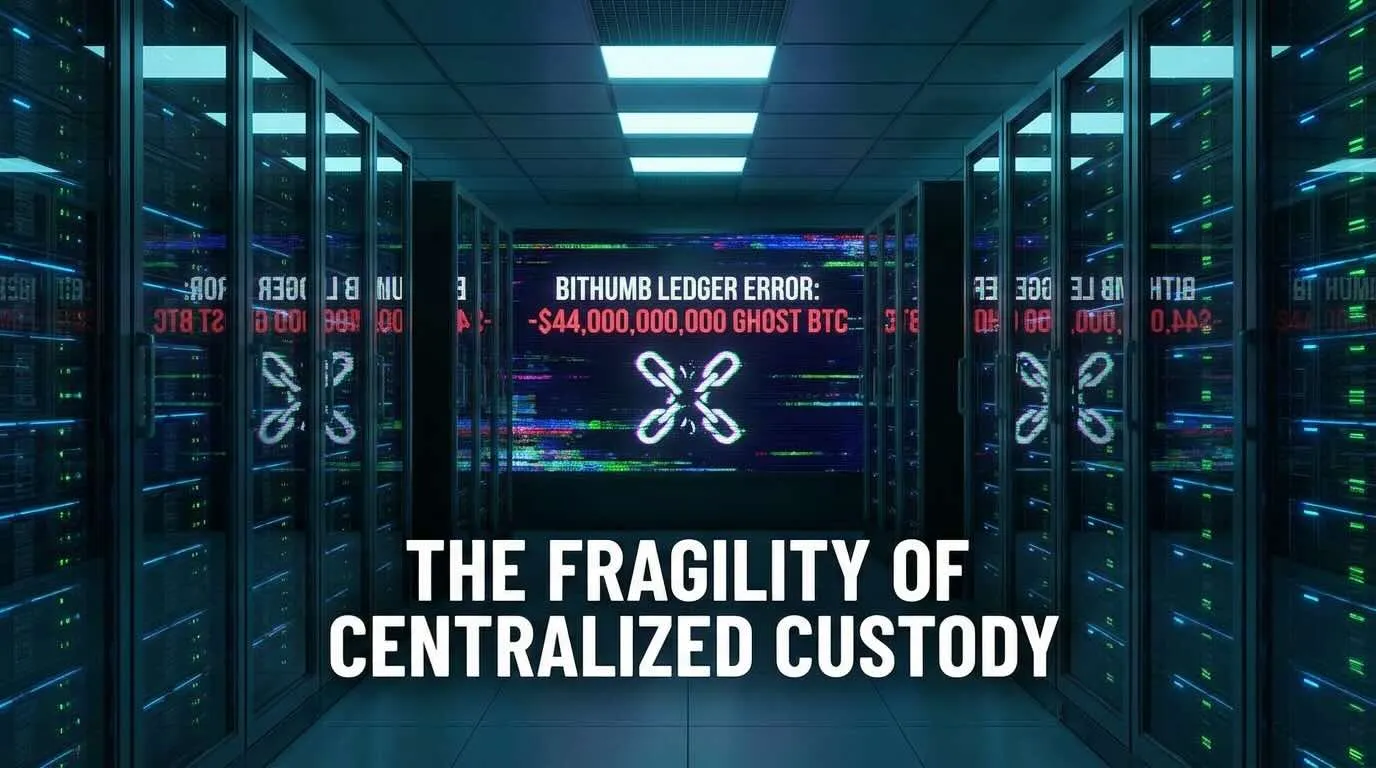
On February 6, 2026, the South Korean exchange Bithumb inadvertently created one of the largest "liquidity mirages" in financial history. During a routine promotional event intended to reward users with 2,000 Korean Won ($1.40), an input error led the system to credit 2,000 BTC ($160M) to 695 individual accounts. This resulted in the sudden appearance of 620,000 phantom Bitcoins—worth approximately $44 billion—on the exchange’s internal ledger.
Risk Disclosure: Centralized exchanges (CEXs) manage assets using internal databases that are decoupled from the blockchain. This "IOU" system means your account balance represents a claim against the exchange, not direct ownership of on-chain coins. High-volatility events can expose discrepancies between ledger entries and actual reserves. This is not financial advice.
The incident was not a hack, but a catastrophic operational error. A staff member mistakenly set the reward unit to "BTC" instead of "KRW."
- The Flash Crash: As "lucky" winners realized they had been credited with billions of dollars, a wave of panic selling ensued. This drove the BTC/KRW price on Bithumb down 15.8% to roughly $55,000, while global markets remained stable above $71,000.
- The "Ghost Coin" Reality: Bithumb’s total BTC reserves at the time were approximately 46,000 BTC. The fact that 620,000 BTC could be "traded" on the platform proves that internal CEX trading does not require real-time on-chain coverage.
Featured Snippet Answer: The Bithumb "phantom BTC" incident occurred on February 6, 2026, when an employee mistakenly credited 620,000 BTC (worth $44B) to user accounts during a 2,000 won giveaway. The glitch caused a localized 15.8% flash crash on the exchange. Analysts emphasize that while this was an operational error rather than a hack, it highlights the systemic risk of centralized exchanges: internal balances are mere database entries (IOUs) that can exist and be traded even without corresponding on-chain assets.
Bithumb’s response was swift, freezing the 695 affected accounts within 35 minutes and recovering 99.7% of the phantom assets. However, the event has triggered an immediate investigation by South Korean regulators into the exchange’s internal controls.
- The FTX Parallel: Unlike the FTX collapse, which involved the malicious misappropriation of customer funds, the Bithumb incident was a manual input error. However, both share the same architectural flaw: a total lack of real-time transparency between the internal ledger and the actual blockchain.
- Compensation Package: To regain trust, Bithumb announced a 7-day fee holiday starting February 9 and promised to compensate users who sold at the "glitch price" with the full sale amount plus an additional 10%.
"Watching a 620,000 BTC sell-wall appear on a single exchange was surreal," says a senior researcher at CryptoQuant. "It is the ultimate proof that 'Proof of Reserves' (PoR) snapshots are insufficient. We need Real-Time Reserve Monitoring where the internal ledger is cryptographically tied to the hot wallets at all times to prevent 'ghost coins' from ever hitting the order book."
- Chosun: Bithumb's Bitcoin Blunder Exposes Weak Controls: https://www.chosun.com/english/market-money-en/2026/02/08/IVSZJ7WBORHC3GAYXFSJTBC44M/ — Analysis of ledger vs. blockchain.
- Bitcoin Magazine: Bithumb Blunder Sends $44 Billion to Users: https://bitcoinmagazine.com/news/bithumb-bitcoin-blunder-sends-44-billion — Breakdown of the flash crash to $55k.
- Yonhap: Bithumb to Reimburse Users After Transfer Error: https://www.techinasia.com/news/south-koreas-bithumb-to-reimburse-users-after-transfer-error — Details on the compensation plan.
- Investopedia: Centralized vs. Decentralized Exchanges: https://www.investopedia.com/centralized-vs-decentralized-exchanges-5271175 — Context on custodial risk.
Q: Was this a hack or a security breach? A: No. Bithumb confirmed it was an internal operational error caused by a staff member inputting "BTC" as the prize unit instead of "Korean Won." No external actors were involved.
Q: Can I still trust Bithumb or other CEXs? A: While Bithumb recovered the funds, the incident proves that CEX balances are IOUs. For maximum security, users should move long-term holdings to self-custody wallets (Hardware Wallets) where the coins actually exist on the blockchain.
Q: How did the "Ghost Coins" affect the global price of Bitcoin? A: The impact was largely localized to Bithumb's KRW pair. Global exchanges like Binance and Coinbase showed minimal reaction because their order books were not flooded with the phantom supply.