

📣 Create Blog for Traders!
Stop Watching news - Start Making it.
START



The Digital Dollar Hedge: How Stablecoins Became the 17th Largest Holder of U.S. Sovereign Debt (2026)
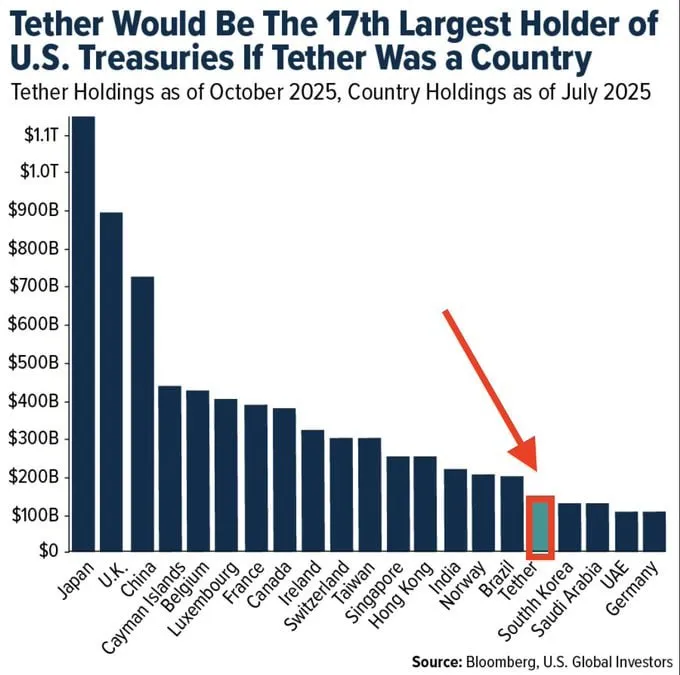
In a historic shift for global finance, Tether (USDT) and the broader stablecoin sector have transitioned from "crypto experiments" to essential pillars of the U.S. Treasury market. As of February 2026, Tether’s holdings of U.S. Treasuries have surpassed those of major sovereign nations, including Germany, South Korea, and Australia, effectively making a private digital asset issuer one of the most significant creditors to the United States.
Risk Disclosure: Concentrating U.S. debt in the hands of private stablecoin issuers creates a new form of systemic risk. While it provides liquidity to the Treasury market, sudden large-scale redemptions could trigger volatility in short-term government bonds. This analysis is for educational purposes only.
According to recent attestations and Treasury data, Tether Holdings now manages a portfolio of U.S. Treasuries exceeding $141 billion (direct and indirect exposure).
- The Ranking: This places Tether as the 17th largest holder of U.S. debt globally.
- Profitability: Tether's 2025 net profit reached an estimated $10 billion, driven almost entirely by the yield generated from these Treasury bills—a business model often described as "the best in the world."
- Expansion: In January 2026, Tether officially launched USA₮, a federally regulated stablecoin designed to meet the strict 1:1 backing requirements of the newly passed Clarity for Payment Stablecoins Act.
[Image showing Tether's Treasury holdings surpassing sovereign nations like Germany and South Korea]
Featured Snippet Answer: As of early 2026, Tether is the 17th largest holder of U.S. Treasuries globally, with over $141 billion in exposure. This rise is fueled by the January 2025 Executive Order signed by President Trump, which officially promoted dollar-backed stablecoins as a tool for "U.S. Dollar Sovereignty." By mandating 1:1 Treasury backing for regulated issuers, the U.S. has turned the $200B+ stablecoin market into a massive, permanent buyer of national debt, helping to absorb the growing $38 trillion U.S. deficit.
The turning point for the industry occurred on January 23, 2025, when President Trump signed the Executive Order "Strengthening American Leadership in Digital Financial Technology." This policy shifted the U.S. stance from "regulation by enforcement" to active promotion.
- Strategic Demand: The administration openly views stablecoins as a critical lever to ensure constant demand for U.S. bonds.
- Countering CBDCs: The order explicitly banned the creation of a U.S. Central Bank Digital Currency (CBDC), choosing instead to rely on private-sector stablecoins (like USDT, USDC, and the Trump family's USD1) to propagate the dollar globally.
- The "Debt Solution": With the national debt exceeding $38.5 trillion in 2026, stablecoin issuers have become a "reliable primary dealer" of last resort, helping to keep short-term borrowing costs lower than they would be otherwise.
"In 2026, we no longer ask if stablecoins are backed; we ask how much of the Treasury market they own," says a lead macro analyst at Cantor Fitzgerald. "The 'Saylor-style' Bitcoin treasury is for growth, but the 'Tether-style' Treasury reserve is for systemic stability. For traders, the stability of USDT is now directly tied to the health of the U.S. bond market—they are two sides of the same coin."
- Tether Official News: Launch of USA₮ (Jan 2026): https://tether.io/news/tether-announces-launch-of-usat/ — Confirmation of 17th place ranking.
- Morgan Lewis: Trump's 2025 Executive Order Analysis: https://www.morganlewis.com/pubs/2025/01/executive-order-digital-assets — Legal breakdown of the shift in U.S. crypto policy.
- Bobsguide: The Clarity Act and Stablecoins in 2026: https://www.bobsguide.com/clarity-act-stablecoins-2026/ — Impact of 1:1 backing on global debt liquidity.
- U.S. Treasury TIC Data: Major Foreign Holders: https://ticdata.treasury.gov/resource-center/data-chart-center/tic/Documents/slt_table5.html — Comparative sovereign holding data.
Q: Why does the U.S. government support Tether now after years of investigation? A: The priorities shifted in 2025. The administration realized that stablecoins provide a massive, "sticky" demand for government bonds, which is essential for funding the national deficit. By bringing issuers under the Clarity Act framework, they transformed a "threat" into a "utility."
Q: Is USDT safer now than it was in 2024? A: Legally, yes. With the launch of federally regulated products like USA₮ and the involvement of custodians like Cantor Fitzgerald and Anchorage Digital Bank, the transparency of reserves is at an all-time high.
Q: What happens if the U.S. defaults on its debt? A: If the U.S. defaults, the "safe assets" backing USDT would lose value, likely causing the stablecoin to de-peg. This is why stablecoin stability is now inextricably linked to U.S. fiscal health.