

📣 Create Blog for Traders!
Stop Watching news - Start Making it.
START



The Institutionalization Paradox: Is Bitcoin Sacrificing Its Soul for Mainstream Success? (2026 Analysis)

The very force that propelled Bitcoin to a record $126,080 in late 2025 is now the subject of intense philosophical debate. As of February 2026, the "Institutional Era" is in full swing, with over $200 billion in assets managed by spot ETFs and corporate treasuries like Strategy Inc. (MSTR). However, this mainstream embrace has forced a painful re-evaluation of Bitcoin’s identity: Is it still a decentralized tool for financial sovereignty, or has it become a high-beta extension of the very system it was built to replace?
Risk Disclosure: The concentration of Bitcoin ownership in institutional hands creates new systemic risks, including increased sensitivity to traditional market interest rates and potential "governance capture." Investors should distinguish between the asset's price performance and its network health. This is not financial advice.
For years, the primary justification for institutional entry was the "Digital Gold" narrative—a non-correlated hedge against inflation. However, the market dynamics of 2025 and early 2026 have shattered this simplistic view.
- Correlation Reality: In the recent 38% drawdown from October 2025, Bitcoin exhibited a 0.80 correlation with the Nasdaq, falling in lockstep with tech stocks while physical gold surged to record highs above $5,600.
- The Reserve Evolution: Recognizing that Bitcoin is not yet a stable "safe haven," the narrative has shifted. Led by the U.S. Strategic Bitcoin Reserve initiatives and pilot programs from sovereign wealth funds (like Norway’s pension fund), the industry now views Bitcoin as a World Reserve Asset—a high-growth digital infrastructure rather than a defensive bunker.
Featured Snippet Answer:
In 2026, Bitcoin's institutionalization has successfully driven price growth but weakened the "Digital Gold" narrative due to high correlation with tech stocks. While the asset has failed as a short-term inflation hedge during recent market stress, it is increasingly being positioned as a "World Reserve Currency" of the digital age. This transition, however, brings a "moderate increase in centralization," as a handful of custodians now control a significant portion of the circulating supply.
The core of the debate is the "Blockchain Trilemma." To gain mass institutional adoption (Security and Scalability), some fear that Decentralization is being sidelined.
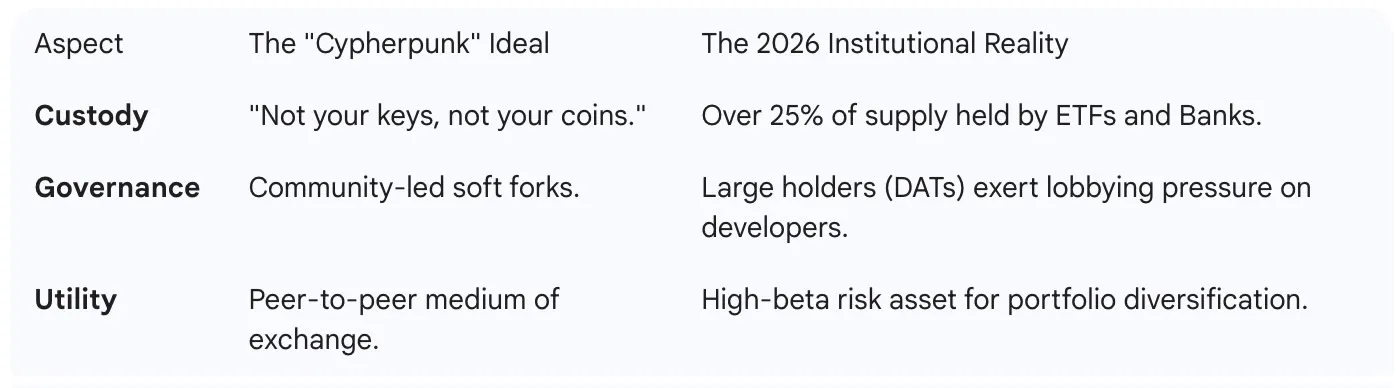
Expert Perspective: "The corruption of the dream is real," notes a lead researcher at Trakx. "Institutionalization brings 'professional' standards—compliance, surveillance, and KYC—which are the antithesis of Bitcoin’s anonymous origins. While this doesn't threaten the protocol's physical security (hashrate), it creates a 'governance layer' that is highly centralized."
As a participant in the TradersWeek community, I have observed that the most dangerous aspect of 2026 is the dominance of "Paper Bitcoin"—claims on BTC held by custodians rather than on-chain coins.
"When you trade a Bitcoin ETF, you aren't participating in a decentralized network; you are participating in a regulated financial product," says a senior macro strategist. "If a major custodian faces a 'Bithumb-style' ledger error or regulatory freeze, the 'Decentralized' nature of the underlying Bitcoin won't save the ETF holder. The institutionalization has effectively built a centralized shell around a decentralized core."
- World Economic Forum: Digital Assets in 2026: https://www.weforum.org/stories/2026/01/digital-economy-inflection-point... — Analysis of the convergence between TradFi and DeFi.
- Bullion Exchanges: Gold vs Bitcoin in 2026: https://bullionexchanges.com/blog/gold-vs-bitcoin-in-2026... — Comparing safe-haven performance during systemic crises.
- Grayscale Research: 2026 Digital Asset Outlook: https://research.grayscale.com/reports/2026-digital-asset-outlook... — The shift from speculative cycles to fundamental growth.
- Trakx: 2026 Crypto Outlook and Centralization Risks: https://trakx.io/resources/insights/2026-crypto-outlook/ — Deep dive into the "Blockchain Trilemma" in the institutional era.
Q: Is Bitcoin still decentralized if a few companies own most of it? A: Yes, in a technical sense. The code is still open-source, and nodes still verify transactions globally. However, in a financial sense, it is more centralized, as a few large entities now have the power to influence market liquidity and price.
Q: Why hasn't Bitcoin acted as a hedge against inflation in 2025-2026? A: Because institutional capital treats it as a "Risk-On" asset. When rates rise or geopolitics spark fear, institutions sell Bitcoin along with stocks to raise cash, whereas they buy gold for stability.
Q: Can the community "fork" away from the institutions? A: Theoretically, yes. But if the institutions (and the billions they bring) stay with the original chain, a "rebel fork" would likely have very little market value or hashrate, making it a symbolic rather than practical victory.