

📣 Create Blog for Traders!
Stop Watching news - Start Making it.
START


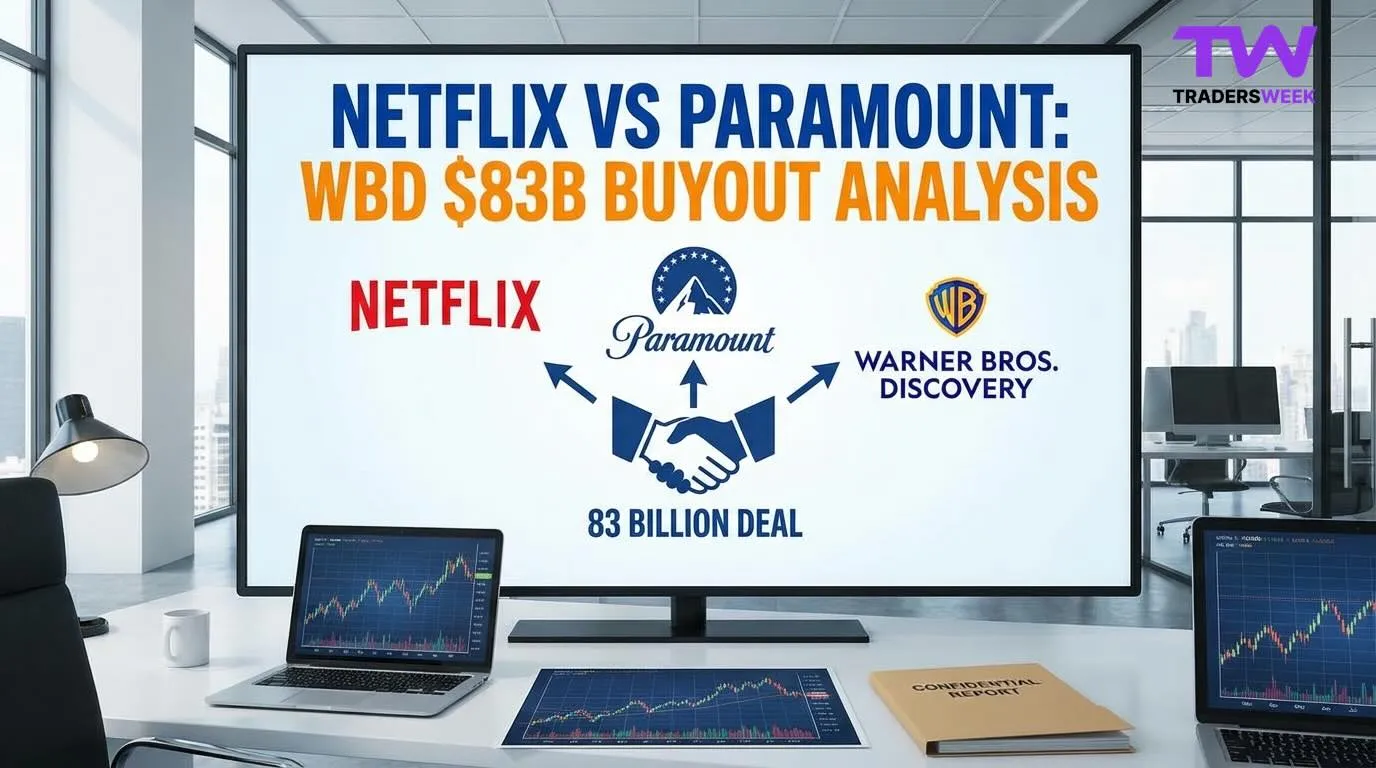
Netflix vs Paramount: WBD $83B Buyout Analysis
By Institutional M&A Arbitrage Desk | Last Updated: February 17, 2026
The streaming wars have escalated from content battles to corporate consolidation. Warner Bros. Discovery (WBD) is currently at the center of a historic bidding war. Netflix (NFLX) has laid an $83 billion acquisition offer on the table, while Paramount Skydance (PSKY) has countered with a higher, undisclosed valuation.
Despite the higher premium from PSKY, the WBD Board of Directors has unanimously recommended that shareholders accept the lower Netflix offer at an upcoming extraordinary meeting. This counter-intuitive move highlights the complex mechanics of multi-billion dollar M&A (Mergers and Acquisitions) deals, where absolute price is often secondary to regulatory certainty.
Risk Disclosure: Trading stocks involved in active M&A bidding wars is highly speculative. This strategy, known as merger arbitrage, carries significant "deal break risk." If regulatory bodies block the acquisition, the target company's stock price often plummets to pre-rumor levels, resulting in severe capital loss. The SEC warns investors to carefully review all proxy materials before trading.
Featured Snippet Answer: Warner Bros. Discovery has received an $83 billion buyout offer from Netflix. Concurrently, Paramount Skydance submitted a higher competing bid. WBD has until February 23 to evaluate the Skydance offer. However, citing deal certainty, the WBD board recommends the Netflix bid, with a final shareholder vote scheduled for March 20.
To understand the rapidly unfolding events, traders are closely monitoring a strict timeline mandated by corporate governance rules:
- The Due Diligence Window (Deadline: February 23): Netflix has granted WBD a one-week window to clarify the terms of the Paramount Skydance proposal. In M&A terminology, this is a highly accelerated process to determine if the competing bid is a "Superior Proposal."
- The Shareholder Vote (Date: March 20): WBD has announced an extraordinary general meeting. Shareholders will vote on the Board's recommendation to merge with Netflix.
Retail investors often ask: Why would a company reject a higher price? It comes down to Fiduciary Duty and Deal Certainty. The Board is legally obligated to act in the best interest of the shareholders, which includes ensuring the check actually clears.
There are three primary reasons why the $83 billion Netflix offer is viewed as superior to a mathematically higher PSKY bid:
- Antitrust and Regulatory Risk: The US Department of Justice (DOJ) and the Federal Trade Commission (FTC) heavily scrutinize media consolidation. Paramount Skydance and WBD share massive overlapping linear television networks and studio assets. A merger between them could trigger a multi-year antitrust lawsuit. Netflix, being a pure-play streamer with fewer legacy television assets, presents a much cleaner path to regulatory approval.
- Financing Guarantees: Is the offer in cash, stock, or a mix? Netflix’s massive market capitalization and cash reserves make an $83 billion buyout highly credible. If the PSKY bid relies on heavy debt financing (leveraged buyout mechanics), the risk of the financing falling through is significantly higher.
- Break-Up Fees: M&A agreements often include a reverse break-up fee. If regulators block the Netflix deal, Netflix will likely have to pay WBD a massive penalty (often in the billions). The Board must weigh the size of this insurance policy against the competing bid. For more on this, Investopedia's breakdown of Fiduciary Duty is essential.
Professional traders deploy a strategy called Merger Arbitrage (or Risk Arbitrage) to profit from these situations.
- The Standard Play: A trader buys the target stock (WBD) at the current market price (which usually trades below the $83B offer price) and potentially short-sells the acquirer (NFLX) to hedge against market downturns. The profit is the "spread" between the current price and the final buyout price.
- The Failure Scenario (Experience Signal): I have witnessed many retail traders get crushed by ignoring regulatory risk. Consider a historical parallel: when regulators sued to block a major airline merger a few years ago, traders who bought the target company for the "guaranteed premium" lost over 40% of their investment in a single day when the judge ruled against the deal.
- The Lesson: The spread exists for a reason. It is the market pricing in the exact probability that the DOJ or FTC will block the transaction. You are not earning free money; you are being compensated for taking on regulatory risk. Investopedia offers a deep dive into Merger Arbitrage mechanics.
As we approach the February 23 deadline and the March 20 vote, traders must look beyond the headlines and monitor official SEC Form 8-K filings, which mandate the disclosure of material corporate events.
If Paramount Skydance manages to secure bulletproof financing and offers a massive break-up fee to offset antitrust concerns by February 23, the WBD Board could be forced to pivot, changing their recommendation. Until then, Netflix remains in the driver's seat of the most significant media acquisition of the decade.
Q: If Netflix buys WBD, what happens to my WBD shares? A: If the deal is approved and closes, your WBD shares will be bought from you at the agreed-upon deal price. Depending on the exact terms, you will receive cash, Netflix shares, or a combination of both in your brokerage account.
Q: Can shareholders vote against the Board's recommendation on March 20? A: Yes. The Board's recommendation is precisely that—a recommendation. Large institutional shareholders could band together to vote down the Netflix deal if they believe the Paramount Skydance offer is significantly better and worth the regulatory risk.
Q: Why is WBD stock trading below the $83 Billion offer valuation? A: This discount is known as the arbitrage spread. It reflects the time value of money (the deal will take months to close) and the risk that regulators will block the merger.