

📣 Create Blog for Traders!
Stop Watching news - Start Making it.
START



Binance Dominance 2026: $409B Volume & The Liquidity Monopoly
By Market Structure & Exchange Analysis Team | Last Updated: February 18, 2026
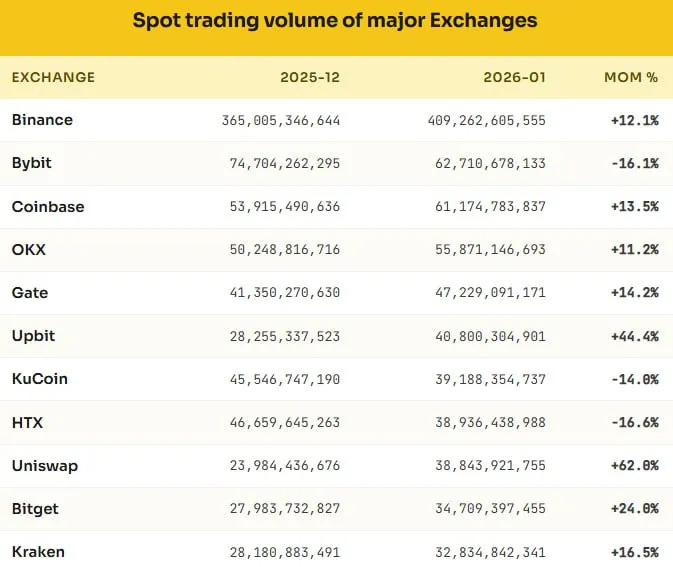
In the fragmented world of cryptocurrency exchanges, liquidity is king. As we entered January 2026, one player has not just maintained its lead but has effectively cemented a monopoly on global liquidity. Binance has reported shattering volume metrics, processing over $409 billion in spot trading volume in a single month.
This figure is approximately 5 times larger than its closest competitor, signaling a massive consolidation of trading activity. Furthermore, on-chain data confirms that Binance has become the primary vault for the industry's "dry powder," holding the majority of all stablecoins on exchanges.
Risk Disclosure: Despite high liquidity, Centralized Exchanges (CEX) carry inherent custodial risks. Past industry failures highlight that "Not Your Keys, Not Your Coins" remains the golden rule. Large reserves do not guarantee immunity from regulatory action or operational failure. Always diversify your holdings.
Featured Snippet Answer: In January 2026, Binance reaffirmed its status as the world's largest spot liquidity center, recording a trading volume of $409 billion. This volume is nearly 500% higher than its nearest rival. For traders, this dominance translates to tighter spreads, lower slippage on large orders, and faster trade execution compared to fragmented liquidity on smaller exchanges.
Why does this $409 billion figure matter for the average investor?
- Slippage Reduction: On low-volume exchanges, a buy order of $50,000 can push the price up by 1-2%. On Binance, the "order book depth" absorbs such trades with negligible price impact.
- Price Discovery: With such a massive market share, Binance effectively sets the global price for assets. Other exchanges often rely on arbitrage bots to align their prices with Binance's feed.
- Altcoin Liquidity: While major pairs like BTC/USDT are liquid everywhere, Binance remains the only venue with sufficient depth for mid-cap and small-cap assets.
Perhaps more impressive than the trading volume is the sheer amount of capital parked on the platform. According to data from CryptoQuant, Binance now holds approximately 65% of all stablecoin reserves across centralized exchanges.
Key statistics regarding these reserves include:
- Total Value: $47.5 billion in stablecoins (USDT, USDC, FDUSD).
- Market Share: 5x more than the second-largest exchange.
- Year-Over-Year Growth: A 31% increase in stablecoin holdings compared to early 2025.
The "Dry Powder" Indicator: Financial analysts view stablecoin reserves as "dry powder"—capital sitting on the sidelines ready to be deployed into Bitcoin or Ethereum. A concentration of $47.5 billion on a single platform suggests that when the next bullish impulse arrives, the buying pressure will originate primarily from Binance's order books.
The narrative of "capital flight" that plagued the exchange in previous years appears to be over. The data indicates a significant stabilization in user behavior.
- Slowing Outflows: Net outflows have decelerated to approximately $2 billion. While this sounds like a large number, in the context of hundreds of billions in assets, it represents a standard operational churn rather than a panic-induced bank run.
- Institutional Return: The 31% growth in reserves suggests that institutional players and high-net-worth individuals have returned to the platform, likely reassured by the exchange's survival through the regulatory storms of 2023-2024.
Is it safe to keep all funds on the largest exchange?
The Bull Case for Binance:
- Execution: Unmatched for active day trading and scalping.
- Fiat On-Ramps: Deepest integration with global payment systems.
- Earn Products: Higher yields due to the massive lending demand.
The Bear Case (Risk Management):
- Single Point of Failure: A 65% concentration of stablecoins creates a systemic risk for the entire crypto market. If Binance sneezes, the market catches a cold.
- Regulatory Target: Being the biggest target makes you the primary focus for regulators in the US and EU.
Expert Recommendation: Use Binance for execution (buying/selling) due to its superior liquidity, but move long-term holdings to cold storage or a hardware wallet immediately after trading.
Q: Why is Binance's volume 5x higher than competitors? A: Network effects. Liquidity begets liquidity. Market makers prefer to quote on the exchange with the most retail flow, and retail traders prefer the exchange with the tightest spreads (provided by market makers).
Q: Is it safe to leave stablecoins on Binance? A: While Binance provides Proof of Reserves (PoR), leaving funds on any centralized exchange involves counterparty risk. The $47.5 billion reserve is a sign of solvency, but self-custody is always safer.
Q: Which stablecoins make up the majority of reserves? A: The majority consists of USDT (Tether) and FDUSD, with a growing share of USDC as compliant stablecoins gain traction in 2026.