

📣 Create Blog for Traders!
Stop Watching news - Start Making it.
START



Uniswap Scam Alert: Phishing Ads Drain Crypto Wallets
By Web3 Cybersecurity & On-Chain Forensics Team | Last Updated: February 21, 2026
In the decentralized finance (DeFi) ecosystem, your web browser is the frontline of your financial security. Recently, the illusion of safety provided by major search engines was shattered again. A crypto trader lost a portfolio valued in the "hundreds of thousands" of dollars simply by clicking on the top Google search result for "Uniswap."
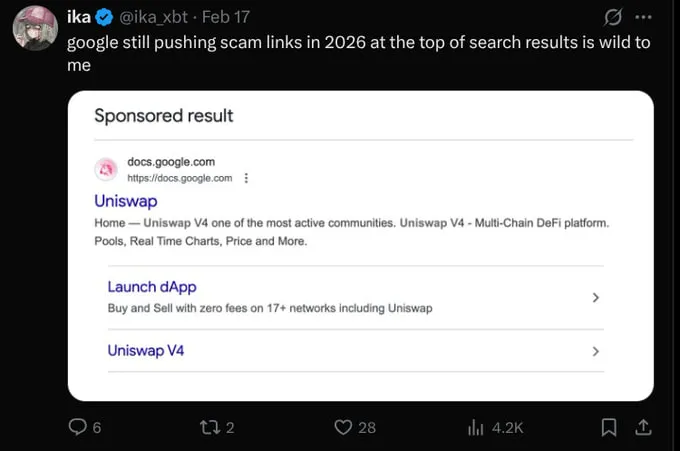
The link was a highly sophisticated sponsored ad leading to a phishing website. This catastrophic loss prompted Uniswap founder Hayden Adams to publicly condemn tech giants for their algorithmic negligence, stating: "These schemes are terrible, we have been fighting them for years... Despite years of reporting ads, they continue to be published." As we navigate the 2026 bull market, retail investors must understand that search engine optimization and App Store algorithms are actively being weaponized by scammers.
Risk Disclosure: In decentralized finance, transactions are immutable. If you sign a malicious smart contract, no bank or customer support team can reverse the transaction or refund your money. You are acting as your own bank, which requires institutional-grade operational security. Always verify URLs independently.
Featured Snippet Answer: A Web3 phishing scam occurs when a user connects their crypto wallet to a fraudulent decentralized application (DApp) that perfectly mimics a legitimate platform like Uniswap. Once connected, the user is tricked into signing a malicious transaction—often an "infinite token approval"—allowing a "wallet drainer" script to instantly steal all cryptocurrencies and NFTs from the victim's wallet.
To protect yourself, you must understand the exact mechanics of the attack. It is not a hack of the blockchain; it is social engineering combined with smart contract exploitation.
The Anatomy of the Scam:
- The Bait (Sponsored Ads): Scammers bid on keywords like "Uniswap," "PancakeSwap," or "DeFi swap." Their ad appears at the absolute top of the search results, tagged as "Sponsored."
- The Cloak: The displayed URL looks legitimate (e.g.,
uniswap.org), but the actual redirect link sends the user to a homoglyph domain (e.g.,unlswap.orgoruniswap.finance). - The Trap: The user interface is a pixel-perfect clone of the real decentralized exchange.
- The Execution: When the user attempts to swap tokens, MetaMask (or another Web3 wallet) prompts them for a signature. Instead of a swap function, the smart contract requests
setApprovalForAllor an infinite token allowance. - The Drain: The moment the user clicks "Approve," the malicious contract gains full control over the user's balances and drains the funds into a mixer (like Tornado Cash) within seconds.
Hayden Adams' frustration highlights a systemic failure in traditional tech infrastructure when interfacing with Web3.
- Search Engine Negligence: Despite utilizing advanced AI for ad targeting, search engines consistently fail to block "Wallet Drainer" syndicates. Scammers bypass automated checks using cloaking techniques—showing a benign website to Google's review bots while redirecting real users to the phishing DApp.
- App Store Hypocrisy: Adams noted a painful irony: while Uniswap Labs waited months for Apple's App Store to approve their legitimate, heavily audited mobile wallet, fraudulent clone applications were routinely approved and published, stealing user funds in the interim.
This environment proves that a "Verified" badge or a top search ranking does not equate to security in the cryptocurrency sector.
Having analyzed dozens of on-chain wallet drains in 2025 and 2026, our forensics team recommends a strict, non-negotiable operational security (OpSec) protocol for all DeFi traders.
- Never Use Search Engines for DApps: Never type "Uniswap" into Google to find the exchange. Go to their verified X (Twitter) profile, find the official link, and bookmark it. Only use your bookmarks.
- Read the Signature: Do not blindly click "Sign" or "Approve." If you are doing a simple swap, your wallet should not be asking for an "Infinite Approval" for all your USDC. Use transaction simulation tools (like Pocket Universe or Fire) that read the smart contract and tell you exactly what will leave your wallet before you sign.
- Compartmentalize Your Assets: Never connect your primary "vault" wallet (hardware wallet) to any DApp. Keep your long-term holdings offline. Move only the exact amount you wish to trade into a temporary "hot wallet," connect that wallet to Uniswap, execute the trade, and move the funds back to cold storage.
For comprehensive security guidelines, the Federal Trade Commission (FTC) provides vital resources on spotting cryptocurrency scams.
The loss of hundreds of thousands of dollars by a single trader is a stark reminder of the unforgiving nature of decentralized finance. While founders like Hayden Adams continue to pressure tech monopolies to clean up their ad networks, the ultimate responsibility rests with the user. Until search engines can effectively banish Web3 phishing links, treating every sponsored ad as a potential wallet drainer is the only way to survive the crypto markets.
Q: Can a scammer drain my wallet just by me visiting the fake website? A: Generally, no. Simply visiting the website will not drain your funds. The scam requires you to actively connect your Web3 wallet and digitally sign a malicious transaction or approval request.
Q: Why doesn't Uniswap just refund the stolen money? A: Uniswap is a decentralized protocol, not a centralized bank. They do not hold user funds, and they have no administrative access to reverse transactions on the Ethereum blockchain.
Q: What should I do if I accidentally approved a scam contract? A: Immediately use a tool like Revoke.cash or Etherscan's Token Approval tool to revoke the smart contract permissions. If the funds have already been drained, report the incident to local cybercrime authorities, though recovery is highly unlikely.
- Security Education: FTC - What to Know About Cryptocurrency Scams
- On-Chain Safety Tools: Revoke.cash - Smart Contract Approvals (Contextual reference for best practices)
- Protocol Documentation: Uniswap Official Security Guidelines (Contextual reference)
- Tech Vocabulary: Investopedia - Phishing