

📣 Create Blog for Traders!
Stop Watching news - Start Making it.
START



Crypto ETF Flows 2026: BTC Outflows vs. Altcoin Rotation
By Institutional Flow & Macro Analytics Team | Last Updated: February 21, 2026
Institutional capital is famously unsentimental. While retail investors often "HODL" through market turbulence, Wall Street actively rebalances its portfolios based on macroeconomic data and risk appetite. In late February 2026, the data indicates a clear, sustained shift in institutional crypto strategy: capital is leaving the majors and slowly trickling into alternative layer-one protocols.
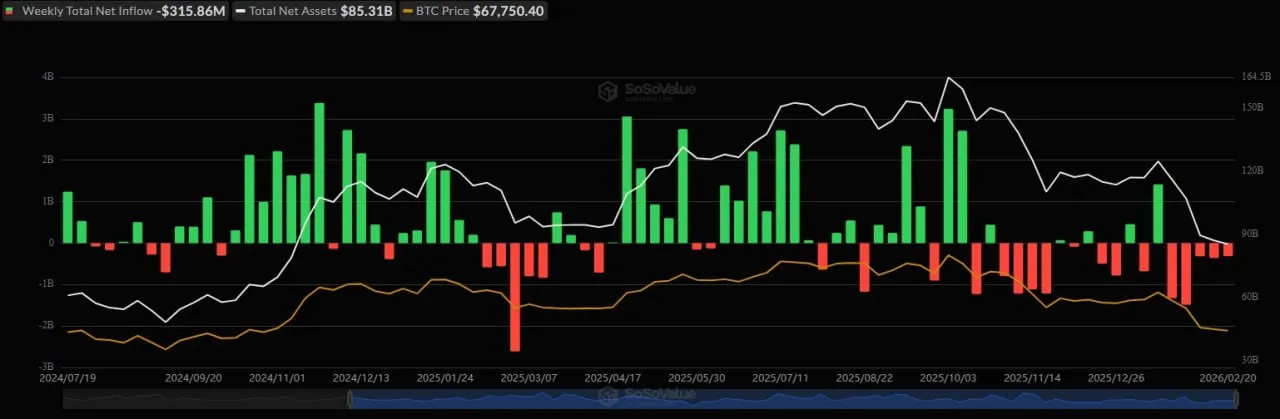
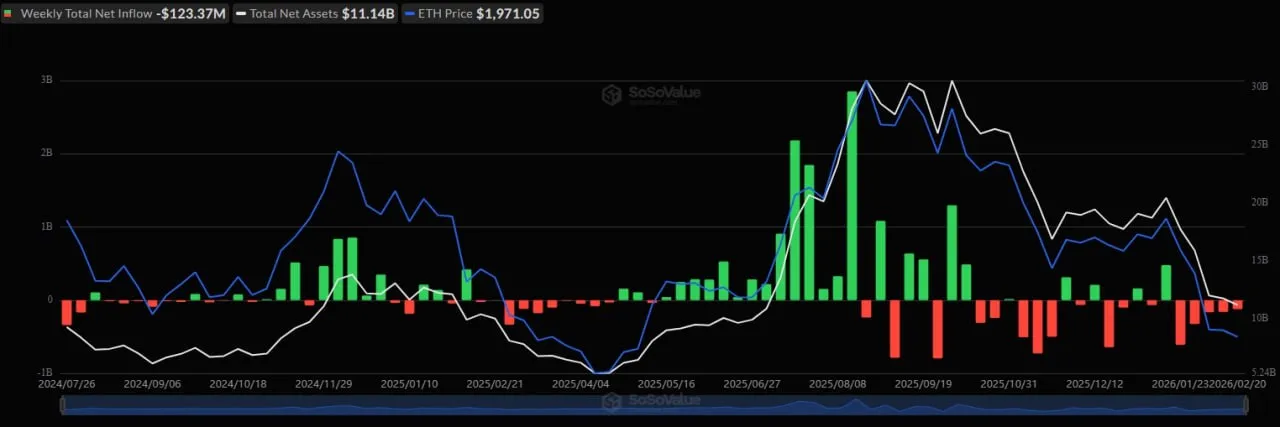
For the fifth consecutive week, spot Bitcoin (BTC) ETFs in the United States have recorded severe capital flight. However, against this bearish backdrop for the market leaders, newly approved exchange-traded products for Solana (SOL) and XRP are seeing positive, albeit comparatively small, inflows.
Risk Disclosure: Exchange-Traded Funds (ETFs) tracking cryptocurrencies are subject to extreme price volatility. AUM outflows can lead to cascading spot market sell-offs. Furthermore, ETFs for alternative coins like SOL and XRP carry higher regulatory and liquidity risks compared to Bitcoin. Investors should consult the SEC’s investor bulletins on crypto-asset risks before allocating capital.
Featured Snippet Answer: Recent US ETF data reveals a 5-week consecutive outflow trend for major cryptocurrencies. Bitcoin ETFs lost $316 million last week, dropping total AUM to $85.3 billion. Ethereum ETFs similarly lost $123 million. Conversely, Solana and XRP ETFs saw positive inflows of $14.3 million and $1.84 million, respectively, signaling a minor institutional capital rotation.
To understand the current market structure, we must break down the exact flows and the underlying Assets Under Management (AUM) for each asset class.
The Majors (Bleeding Capital):
- Bitcoin (BTC): Net outflows reached $316 million for the week. This marks the fifth consecutive week of negative flows. Despite the bleed, BTC ETFs remain the undisputed heavyweight champion with an aggregate AUM of $85.3 billion.
- Ethereum (ETH): Mirroring Bitcoin's trajectory, ETH funds bled over $123 million. Total AUM for Ethereum products is currently hovering just above $11 billion, struggling to capture the same institutional enthusiasm as its older sibling.
The Challengers (Attracting Capital):
- Solana (SOL): Displaying surprising resilience, SOL ETFs captured $14.3 million in fresh capital. The total AUM sits at approximately $740 million.
- XRP: XRP-based funds saw a modest inflow of $1.84 million, pushing their total AUM to the $1 billion milestone.
Traders often refer to the phenomenon we are witnessing as Capital Rotation. It is not necessarily a sign that institutions hate Bitcoin; rather, it is a strategic reallocation of risk.
- Profit Taking on the Majors: Bitcoin ETFs saw historic, record-breaking inflows throughout 2024 and 2025. Institutional managers who bought at lower valuations are likely rebalancing their portfolios, locking in profits ahead of potential macroeconomic headwinds (like inflation data or central bank policy shifts).
- The "New Product" Premium: ETFs for SOL and XRP are much newer to the US market. Wealth advisors are currently in the initial allocation phase for these assets. When a new fund launches, it naturally sees initial inflows as clients diversify their 1-5% crypto allocation sleeves.
- The Denominator Effect: It is crucial to maintain perspective. Investopedia defines AUM as the total market value of the investments a financial institution manages on behalf of clients. A $14 million inflow into Solana looks impressive until you realize Bitcoin's AUM is over 115 times larger ($85.3B vs. $740M).
From a trading desk perspective, ETF flows are a lagging, but powerful, indicator.
- The Trap: Retail traders often panic-sell when they see "$316M Outflow" headlines. However, in a market where Bitcoin trades tens of billions of dollars in daily spot volume globally, a $316 million ETF outflow over a week is easily absorbed.
- The Alpha: The real signal lies in the divergence. The fact that traditional finance (TradFi) investors are actively buying Solana while selling Bitcoin suggests an increasing institutional appetite for high-beta, smart-contract platforms. When the macro environment turns bullish again, the assets that showed positive inflows during the downtrend (like SOL) often outperform the market leaders in the subsequent rally.
The five-week outflow from Bitcoin ETFs highlights a period of institutional consolidation and profit-taking in early 2026. While the total AUM of Bitcoin dwarfs all other crypto assets combined, the sustained inflows into Solana and XRP ETFs prove that Wall Street's interest in digital assets extends beyond "digital gold." As the market matures, monitoring these capital rotations will be essential for predicting the next major sector rally.
Q: What does AUM mean in crypto ETFs? A: AUM stands for Assets Under Management. It represents the total fiat dollar value of the physical cryptocurrency (BTC, ETH, SOL, etc.) held by the fund issuers (like BlackRock or Fidelity) on behalf of their shareholders.
Q: If Bitcoin ETFs are seeing outflows, does that mean the price will crash? A: Not necessarily. While ETF outflows create selling pressure, ETFs only represent a fraction of the global Bitcoin market. Spot trading on major exchanges and macroeconomic factors often have a more immediate impact on price.
Q: Why are SOL and XRP seeing inflows while BTC drops? A: This is likely due to the recent launch of these specific ETFs, leading to initial portfolio allocations by institutional clients seeking diversification outside of Bitcoin and Ethereum.
- Macro Education: Investopedia - Assets Under Management (AUM)
- Regulatory & Risk Warnings: SEC.gov - Crypto Assets Investor Alerts
- Financial Mechanics: Investopedia - Capital Rotation