

📣 Create Blog for Traders!
Stop Watching news - Start Making it.
START


DeFi Protocol Analysis: My Method for Finding Real Yield
Forget the hype. I'm breaking down the exact on-chain metrics I use to find protocols worth investing in before the crowd catches on.
This morning, my routine started as usual: coffee, and a deep scan of DefiLlama. But something jumped out from my custom dashboard. The 'Real Yield' sector has seen its fee generation quietly climb by over 30% this quarter, while its Total Value Locked (TVL) only grew by 12%. That tells me these protocols are becoming brutally capital efficient. They're printing real cash for users, not just inflationary tokens to prop up a high APY. While my colleague Marcus Cole is probably glued to the ETH 4-hour chart, I'm watching the on-chain cash flow. This is where the real alpha is, and to find the best DeFi protocols to invest in, you need a framework that cuts through the noise. Here's mine.
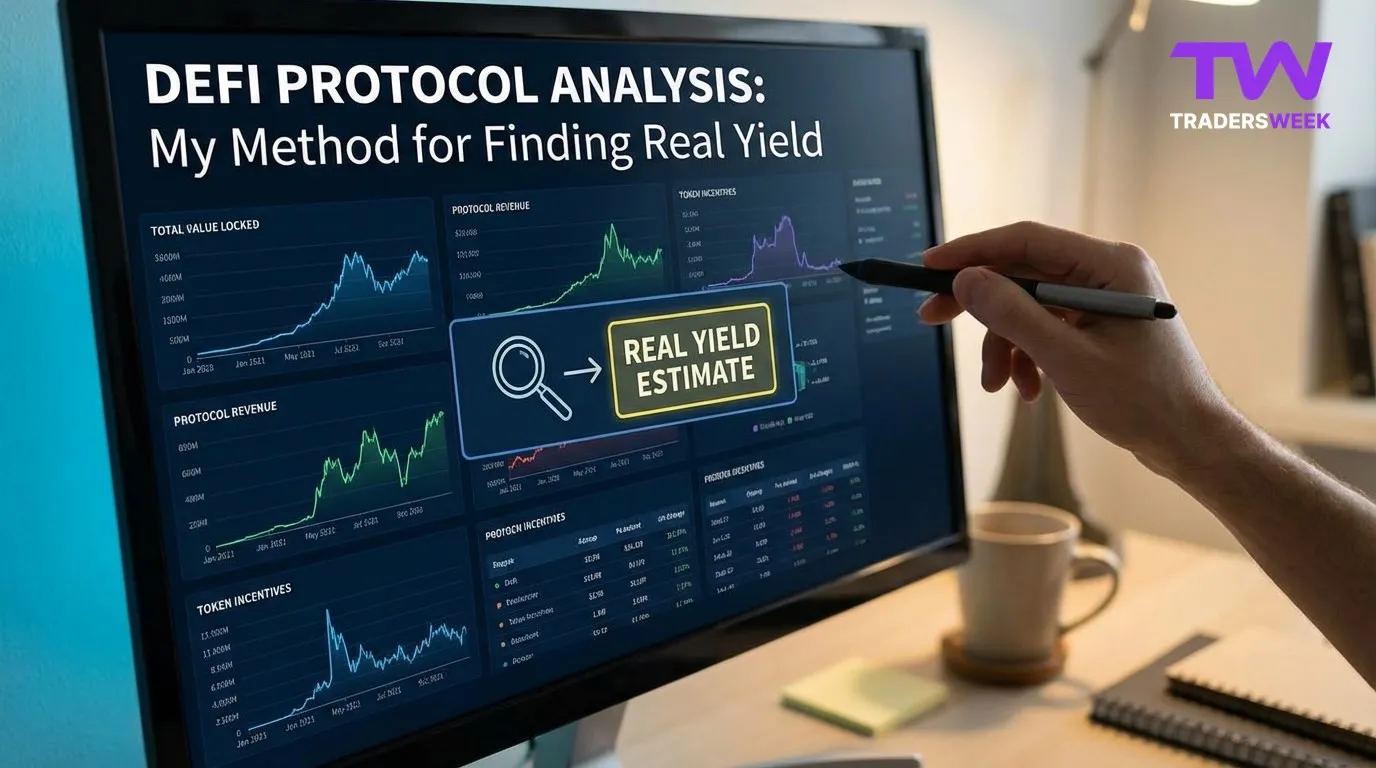
Let's get one thing straight: TVL is mostly a vanity metric. I got into this space during the 2020 DeFi Summer, farming YAM at 3 AM, and I saw firsthand how easily TVL can be manipulated with mercenary capital and crazy token emissions. It tells you how much money is sitting in a protocol, but not if that money is doing anything useful. Is it generating fees? Is the protocol profitable? Is anyone actually *using* the thing? These are the questions that separate a sustainable investment from a farm-and-dump token.
I look at a protocol's on-chain data like a company's financial statement. The key is understanding the difference between fees and revenue. Fees are what users pay to use the service. Revenue is the cut the protocol itself (and by extension, its token holders) gets to keep. A protocol like UNI generates enormous fees, but very little of that currently goes back to the protocol or its holders. Contrast that with a protocol like GMX, which shares a significant portion of its fee revenue directly with stakers. That's a fundamental difference in tokenomics.
- Daily Active Users (DAU): Is the user base growing, or is it a ghost town?
- Protocol Revenue: Is the protocol actually profitable after emissions?
- Price-to-Sales (P/S) Ratio: Compare market cap to revenue. Is it cheap or expensive?
- Token Inflation Rate: Is my yield real or just being diluted away by token printing?
I've been burned by three rug pulls. I'm not letting it happen a fourth time. My rule is simple: if you can't read the audit, you shouldn't invest. I actually enjoy reading audit reports from firms like Trail of Bits or OpenZeppelin. You're not looking for a perfect score; you're looking at the *types* of issues found and whether the team fixed them. Are there major centralization risks, like an owner key that can drain all the funds? Pass. Hard pass.
And look for timelocks on the smart contracts. A timelock means that any major change to the protocol (like upgrading a contract or moving treasury funds) has a mandatory waiting period. A 24-hour timelock is the absolute minimum I'll accept. It prevents instant, malicious changes and gives users time to exit if they don't like a proposed update. It’s a basic form of risk management, a concept Alex Volkov covers extensively for traditional markets, but in DeFi, it’s not an option—it's a necessity.
So where does this framework lead me? Straight to Real World Assets (RWA). I've allocated about 20% of my personal portfolio here. Why? Because this is the bridge between TradFi and DeFi that actually makes sense. Protocols in this space, like Ondo Finance or Centrifuge, tokenize things like U.S. Treasuries or private credit. They generate predictable, real-world yield that's paid out on-chain. Their revenue isn't based on speculative trading volume; it's based on the yield of the underlying assets. This is the kind of model that will survive a bear market and attract serious capital.
When we talk about the coming wave of institutional DeFi adoption, they aren't going to be aping into unaudited food-themed farms. They will demand protocols with transparent on-chain financials, robust security, and yield sourced from outside the crypto echo chamber. They'll use a framework just like mine. The difference is, we can get there first.
Stop chasing phantom APYs from inflationary tokens. The only sustainable yield farming strategy for 2026 will be owning a piece of protocols that generate cold, hard cash from real, verifiable usage.
This isn't just about finding the next 100x. It's about building a resilient DeFi portfolio that can weather any market condition by focusing on fundamental value. The data is all there, on-chain, for anyone to see. You just have to know where to look. Everyone's waiting for an ETF to kick off the next bull run, but what if the real catalyst is DeFi protocols becoming so undeniably profitable that institutions simply can't afford to ignore them anymore?