

📣 Create Blog for Traders!
Stop Watching news - Start Making it.
START



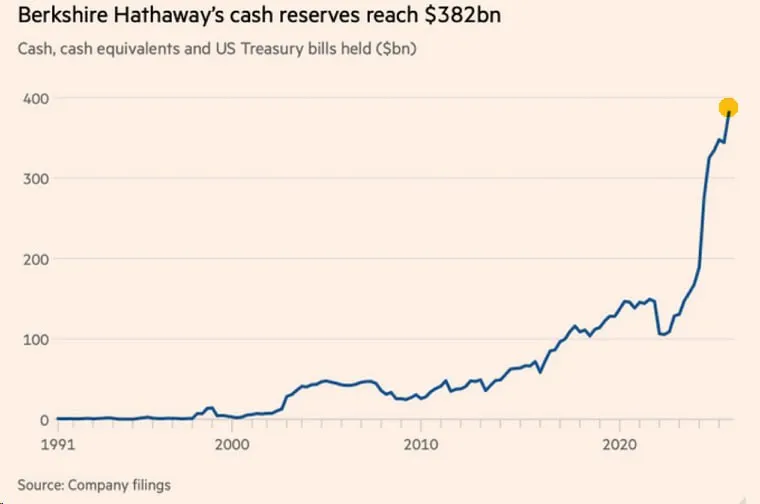
Berkshire Hathaway Cash Record: 2026 Market Warning
By Macroeconomic Strategy & Value Investing Team | Last Updated: February 23, 2026
In the world of global finance, silence can be deafening. While retail traders chase new all-time highs and hedge funds aggressively increase their long positions in US equities, the most successful value investor in history is sitting on his hands. According to recent corporate filings, the cash pile on Berkshire Hathaway's balance sheet continues to shatter historical records in early 2026.
Warren Buffett and his portfolio managers are completely abstaining from significant purchases in the US stock market. This massive accumulation of capital is not an accident; it is a direct continuation of Buffett's May 2025 declaration that he sees absolutely no compelling buying opportunities in the near term. For retail investors, this divergence between Wall Street euphoria and Berkshire's defensive posturing is the ultimate macroeconomic red flag.
Risk Disclosure: Holding large amounts of cash during a bull market carries the risk of "opportunity cost" and inflation degradation. While tracking institutional moves like those of Berkshire Hathaway is educational, retail investors must remember that a $900 billion conglomerate has entirely different liquidity needs and time horizons than an individual trader. Never blindly copy institutional trades without consulting a certified financial planner.
Featured Snippet Answer: Berkshire Hathaway’s record cash pile indicates that CEO Warren Buffett and his team believe the US stock market is severely overvalued. By abstaining from significant equity purchases, the conglomerate is actively preserving capital to deploy during a future market correction, prioritizing the guaranteed yield of US Treasury bills over the high risk of inflated tech stocks.
To understand the mechanics of this strategy, we must dispel a common myth. Berkshire Hathaway's "cash" is not sitting in a zero-interest checking account.
- The Treasury Bill Strategy: The vast majority of these reserves are parked in short-term US Treasury Bills (T-bills).
- The Yield Advantage: Even with fluctuating interest rates, these T-bills provide a massive, risk-free annual return. Berkshire is effectively being paid billions of dollars a year simply to wait.
- The Capital Allocation Dilemma: Buffett's primary rule is "Rule No. 1: Never lose money." When the projected earnings yield of the S&P 500 drops below the guaranteed yield of a 3-month Treasury bill, value investors instinctively halt their equity purchases.
Why exactly did Buffett state in May 2025—and reaffirm through his actions in 2026—that there are no buying opportunities? Financial analysts point to his favorite macroeconomic gauge: The Buffett Indicator.
The Buffett Indicator is a simple ratio that divides the Total US Stock Market Capitalization (often measured by the Wilshire 5000 index) by the annualized US Gross Domestic Product (GDP).
- Fair Value: Historically, a ratio of 100% (Market Cap equals GDP) suggests the market is fairly valued.
- The Danger Zone: Any reading above 150% is considered significantly overvalued.
- The 2026 Reality: Throughout the recent market rallies, this indicator has consistently hovered near or above historical extremes, surpassing even the levels seen during the Dot-Com bubble. From a pure mathematical standpoint, paying these premiums goes against every fundamental principle of Benjamin Graham's value investing philosophy.
For a deeper technical breakdown of this metric, Investopedia's explanation of the Market-Cap-to-GDP Ratio is an essential resource.
It is incredibly difficult to execute this strategy as a retail investor.
From a portfolio management perspective, holding cash while your peers are posting massive gains from tech stocks and crypto is psychologically agonizing. This phenomenon is known as FOMO (Fear Of Missing Out).
- The Retail Mistake: Retail traders often cave to this pressure, deploying their cash reserves right at the top of a market cycle out of pure frustration.
- The Institutional Patience: Warren Buffett does not experience FOMO. He refers to the stock market as a game where you do not have to swing at every pitch. You can stand at the plate for years, waiting for the perfect "fat pitch."
- The Lesson: Berkshire's record cash pile is a masterclass in psychological discipline. They are willing to suffer short-term "cash drag" (underperforming a raging bull market) to ensure they have the ammunition to buy premier companies at bargain prices during the next inevitable recession.
The continuous expansion of Berkshire Hathaway's cash reserves into record territory is the loudest silent alarm in the financial markets today. While the retail crowd and heavily leveraged hedge funds continue to push equity valuations to new extremes, the smartest money in the room is quietly building a fortress. Until the fundamental valuations of American businesses correct to historical norms, expect the Oracle of Omaha to keep his wallet firmly closed.
Q: Is Warren Buffett predicting a stock market crash? A: Not necessarily a crash, but he is acknowledging that expected future returns at current prices are exceptionally low. By holding cash, he is positioning the company to act aggressively when a correction eventually happens.
Q: Where does Berkshire Hathaway keep its cash? A: Almost exclusively in short-term US Treasury bills, which are considered the safest financial instruments in the world and provide a steady, risk-free interest yield.
Q: Should I sell all my stocks to hold cash like Buffett? A: No. Berkshire Hathaway is a massive insurance conglomerate that requires immense liquidity to pay out potential catastrophic claims. Retail investors with decades until retirement generally benefit from dollar-cost averaging into index funds, rather than trying to perfectly time the market.
- Macro Valuation Tool: Investopedia - Market Capitalization to GDP Ratio (Buffett Indicator)
- Corporate Filings: SEC.gov - EDGAR Company Filings (Berkshire Hathaway 10-Q/10-K)
- Risk Management Education: SEC.gov - Asset Allocation and Diversification