

📣 Create Blog for Traders!
Stop Watching news - Start Making it.
START


India vs. S&P 500: Where I'm Putting My Capital Now
Global funds are rotating back into emerging markets. My analysis shows why Indian equities might offer better risk-adjusted returns than the crowded US tech trade.
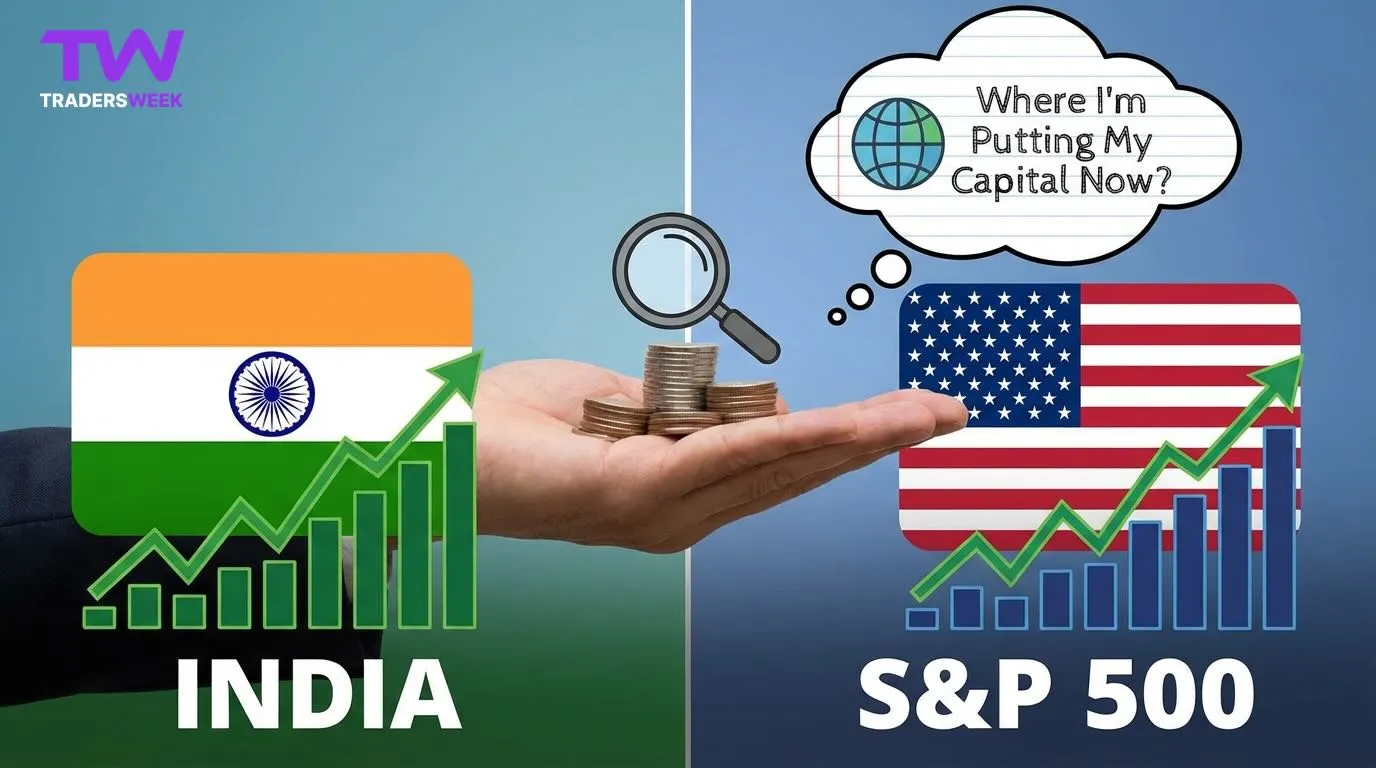
Last time we saw a capital flow reversal this sharp was back in Q4 2022, just before the market bottomed. This morning, my pre-market scan lit up with a Bloomberg report: global funds have resumed buying Indian stocks. After a net outflow of $3.3 billion in January, they poured $1.7 billion back in this month. This isn't just noise; it's a signal. And it forces a critical question for any serious strategist: is the alpha now in emerging markets like India, or does the stalwart S&P 500 still reign supreme? For my money, I'm starting to lean east.
I left Goldman Sachs to trade my own book, and that means looking for growth stories that aren't already priced to perfection. India fits that description. The reversal in fund flows is the catalyst, but the underlying story is built on solid fundamentals. My models are flagging a powerful combination of demographic tailwinds and pro-growth policy. We're looking at a consensus GDP growth forecast of around 6.5% for 2024, dwarfing the 2.1% projected for the U.S. This isn't just a number; it translates directly into corporate earnings potential.
I spent the weekend digging through the filings for some of the top holdings in the iShares MSCI India ETF ($INDA). What I found was a healthy mix of financials, industrials, and consumer discretionary companies poised to benefit directly from this domestic growth. Unlike the U.S., it's not a market propped up by a handful of tech behemoths. The Nifty 50 is trading at a forward P/E of around 20.5x. Yes, that's a premium, but it's justified by an earnings growth forecast in the mid-teens. It's a classic growth-at-a-reasonable-price (GARP) setup that I find compelling.
And then we have the S&P 500. It's the champion, the default long for a generation of investors. But I'm cautious. My concern is concentration risk. The top 10 companies make up over 30% of the index. As we head into the next earnings season preview, the entire market's fate rests on the shoulders of a few tech giants meeting incredibly high expectations. The forward P/E for the S&P 500 is also around 20x, but with significantly lower aggregate growth prospects than India. My S&P 500 price forecast for year-end is muted, perhaps around the 5,300 level, as valuations seem stretched relative to the macro environment. As my colleague Jake Morrison often points out, when the VIX is this low, it's usually a time for caution, not complacency.
- Projected GDP Growth (2024): India at ~6.5% vs. U.S. at ~2.1%
- Forward P/E Ratio: Roughly equal at ~20-21x, but India has a higher earnings growth forecast.
- Sector Concentration: S&P 500 is heavily weighted to Tech. India's Nifty 50 is more balanced with Financials, IT, and Energy.
- Key Risk: India faces currency/political risk. The S&P 500 faces valuation/concentration risk.
This is the kind of global capital flow analysis that Alex Volkov excels at, and his macro view often informs my equity positioning. The U.S. dollar's strength has been a headwind for emerging markets, but if the Fed signals a pivot later this year, that headwind could quickly become a tailwind for assets like $INDA. For my portfolio, the risk-adjusted return profile for Indian equities over the next three years looks superior to the S&P 500.
I'm not liquidating my U.S. holdings. My core portfolio remains anchored in large-cap U.S. stocks. But I have been building a position in $INDA over the past two weeks, using the January dip as my entry point. My thesis is simple: the world needs growth, and India is one of the few large economies that can deliver it organically. The primary risks are a sudden spike in energy prices, as India is a major importer, or a 'higher for longer' stance from the Fed that keeps the dollar strong. I'm keeping a close eye on the USD/INR currency pair as a key indicator for my thesis. A break above 83.5 would have me re-evaluating my position size.
The easy money in U.S. tech has been made. The next decade's alpha will be found in markets with real demographic and economic tailwinds, and India is at the top of that list.
Ultimately, this is a bet on fundamentals over momentum. The S&P 500's momentum is undeniable, but the fundamentals are showing their age. The opposite is true for India. The momentum is just beginning, and it's backed by the most compelling fundamental growth story on the planet. I'm positioning myself accordingly. So, is the S&P 500's massive concentration in just a few tech stocks a feature that ensures its dominance, or a bug that signals a major correction ahead?
Read More on TradersWeek:→ US Copper Stockpiles 2026: The Macro AI Squeeze→ LEAPS Investing: A Smarter Way to Buy Options→ Prop Firm Payouts: My $180K+ Payout Report Card
SPY chart · Powered by Finviz
Trading ToolsStock Screener · S&P 500 Map · Try FINVIZ Elite Free