

📣 Create Blog for Traders!
Stop Watching news - Start Making it.
START



Solar Superstorm 2026: Earth Braces for G5 Extreme Conditions
The Sun has just launched its opening salvo of 2026. Following a long-duration X1.9-class solar flare from active region 4341, a massive Coronal Mass Ejection (CME) impacted Earth's magnetosphere early this morning, January 20, 2026.
Current Status (As of 09:00 AM):
- Intensity: The storm quickly reached G4 (Severe) levels and, according to researchers at IKI RAS, surged to G4.7, teetering on the edge of the maximum G5 (Extreme) rating.
- Radiation Storm: Simultaneously, an S4 (Severe) solar radiation storm is in progress—the largest in over 20 years (since 2003).
- Solar Wind Speed: Probes are recording speeds exceeding 1,000 km/sec, a rare and violent velocity for solar plasma.
The "Extreme" Risk (G5): Scientists warn that if the magnetic orientation of the solar wind (Bz-component) remains southward, we will hit G5. This hasn't happened since the historic May 2024 event.
- Grid Vulnerability: G5 storms can cause widespread voltage control problems and protective system failures. Power grids in high-latitude regions (Canada, Scandinavia, Northern US) are on high alert.
- Navigation & Satellites: High-frequency (HF) radio communications are currently blacked out in polar regions. GPS accuracy is expected to degrade significantly throughout the day.
- SpaceX & Starlink: Operators are closely monitoring satellite drag, as intense storms heat and expand the Earth's upper atmosphere, potentially pulling low-orbit satellites out of their trajectories.
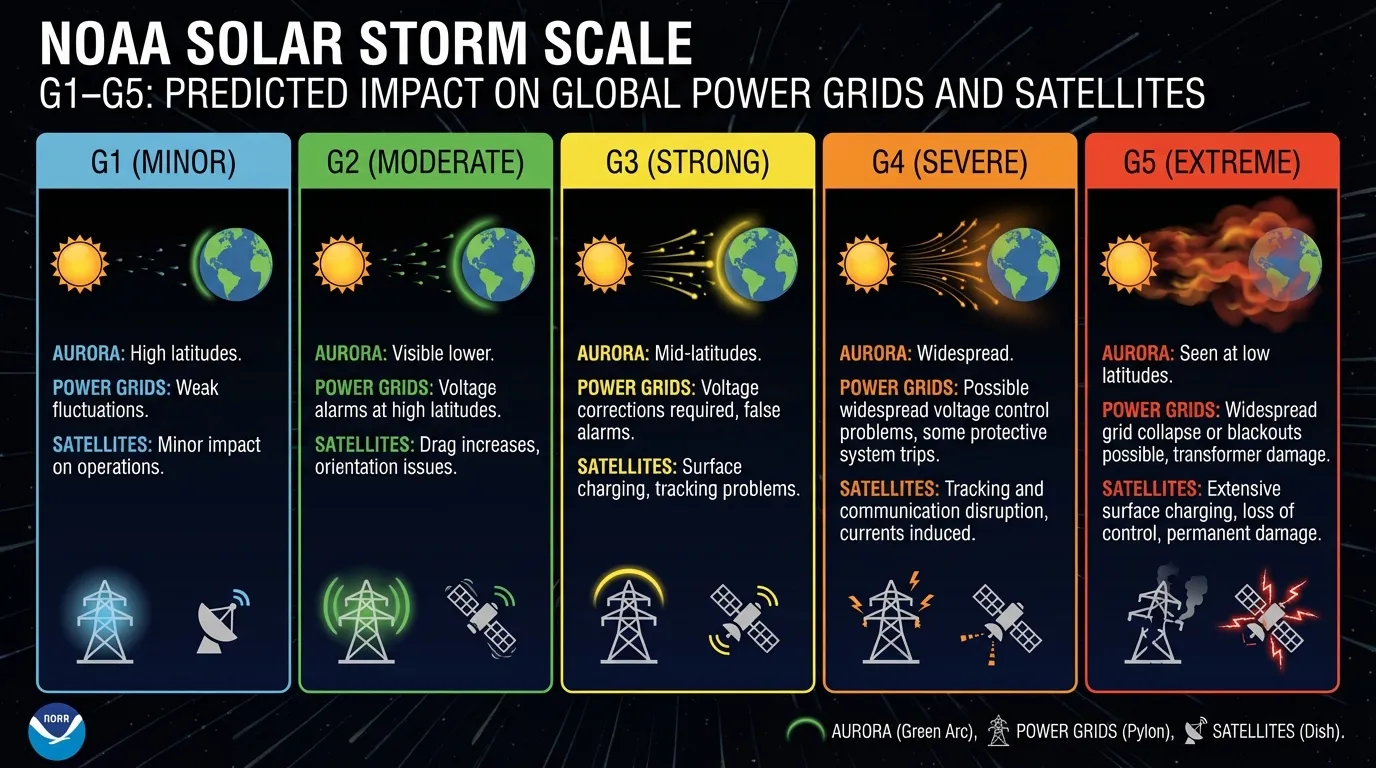
The "Aurora Hunt": Where to Look? Thanks to the intensity of the G4/G5 conditions, the Aurora Borealis (Northern Lights) is expected to be visible much further south than usual:
- North America: Visible as far south as Kansas, Nebraska, and even Pennsylvania.
- Europe/Eurasia: Visible in the skies of Central Russia, Germany, and potentially northern parts of France and the UK.
- Peak Time: The best viewing window is between 18:00 and 03:00 UTC on January 20-21.
Market Context: For crypto and stock traders, "Space Weather" is no joke. Intense storms can cause temporary "glitches" in data center connectivity and high-frequency trading (HFT) systems. As we head into the Tuesday market open (already stressed by Trump's tariffs), the added technical risk from a G5 storm is creating a "perfect storm" of uncertainty.
The solar cycle is reaching its peak in 2026. Today's event is a reminder that our digital civilization remains at the mercy of the Sun's activity. While the aurora will be spectacular, the potential for power grid fluctuations and satellite disruptions makes this the most significant space weather event of the decade.
⚠️🔭 #SpaceWeather #SolarFlare #MagneticStorm #G5 #NorthernLights #TechImpact2026